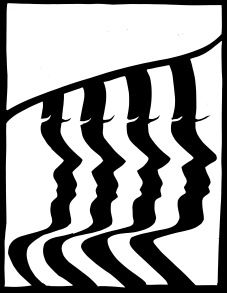
Greg Dunn Combining Neuroscience with the Artistic Process

Brainbow Hippocampus, 22K gilded microetching in custom frame

This article is a review of a 2015 exhibit at the Mutter Museum  by Greg Dunn.    So appropriate for the Science Day March but amazing everyday!

PHILADELPHIA, PA – This summer the Mütter Museum is showcasing Mind Illuminated, a dazzling solo exhibition featuring the work of Philadelphia artist and neuroscientist Greg Dunn. Dunn’s paintings of neurons rendered in an Asian art style have been widely acclaimed for their fusing of art and science, earning him a recent exhibit at the New York Hall of Science and coverage in Wired, The New York Times, The Huffington Post, Scientific American, and many other national and international publications. Dunn also received a top prize in the National Science Foundation’s International Science and Engineering Visualization Challenge in 2013.

In addition to paintings on gold leaf and hanging scrolls, Mind Illuminated will consist of microetchings of vast networks of neurons created in collaboration with Dr. Brian Edwards, an artist and applied physicist at the University of Pennsylvania.  Microetchings integrate art, optics, and engineering to give two dimensional surfaces an extra dimension of directional reflectivity, imparting unprecedented levels of clarity and expressivity to complex neural forms.

“Microetchings allow the viewer to clearly perceive complex images in a way that is impossible through two-dimensional renderings,” says Dunn of the Mind Illuminated exhibition. The centerpiece of the exhibit will be a large microetching that integrates the unmistakable parallels between the forms and behaviors of biological neural networks and traffic patterns of the city of Philadelphia.”

Robert D. Hicks, PhD, Director of the Mütter Museum and Historical Medical Library, says, “We are very excited to exhibit Philadelphia artist Greg Dunn’s pieces in our new contemporary art gallery space. When we first saw Greg’s images of neuro-matter shimmering with gold leaf and presented as sumi-e scrolls, we were dazzled. Usually associated with Japanese or Chinese contemplative inked scenes of mountain passes and landscapes, scrolls of this style, in Greg’s hands, imagine the neural universe of our thoughts and memories. Teamed with another artist-scientist Brian Edwards, Greg has undertaken a series of what they call microetchings that suggest the physical dimension of human consciousness much as the Hubble Space Telescope has shown our universe back to the beginning of time.

at http://muttermuseum.org or by calling (215) 560-8564.

###

About Artist Greg Dunn: Dr. Dunn received his PhD in neuroscience from the University of Pennsylvania in 2011. While a graduate student, Dunn fused his love of Asian art and neuroscience into expressive pieces demonstrating that the qualities of neural forms cleanly fit into the aesthetic principles of minimalist Asian art and sumi-e scroll and gold leaf painting. Dunn is now a full time artist out of Philadelphia where he works to incorporate his knowledge of neuroscience, physics, and biology into the artistic process through imagery, concept, and technique. His work hangs at Johns Hopkins, Carnegie Mellon, the Society for Neuroscience headquarters, as well as universities, institutions, and private collections all over the world.

###

The College of Physicians of Philadelphia was founded in 1787, now one of the oldest professional medical organizations in the country, when 24 physicians of Philadelphia gathered “to advance the science of medicine and to thereby lessen human misery.” Today, more than 1,400 Fellows (elected members) continue to convene at the College and work towards better serving the public.

The College is home to the Mütter Museum and the Historical Medical Library. The Mütter Museum is America’s finest museum of medical history, which displays collections of anatomical specimens, models and medical instruments in a nineteenth-century setting. This includes a biannual rotation of art exhibits that accompany the themes and aims of the museum’s collections.

to see more work by Greg Dunn http://www.gregadunn.com

Art Therapists Speak Out-Karen Pence Stop!

http://petitions.moveon.org/sign/karen-pence-stop-your?source=c.em&r_by=4658086

Karen Pence STOP your plan to “make people aware of what art therapy is and how it works,”

To be delivered to Karen Pence, Wife of the Vice- president

We question your intentions and qualifications. We need you to publicly take action for the rights of LGBTQIA people, people of color, Muslims, survivors of sexual assault, people with disabilities, immigrants, refugees and all people who are in danger as a result of the policies of the current administration. Art therapist care about health, human rights and social justice. Do you?
There are currently 63 signatures. NEW goal – We need 100 signatures!

Petition Background

To give a voice to art therapists that disagree with the national AATA organizations alliance with Karen Pence , the second lady. I am an art therapist who will be negatively affected by Pence’s uneducated explanation of the profession.

Artists that Create Action from Springboard for the Arts Web

Rebecca Solnit on Hope in Dark Times, Resisting the Defeatism of Easy Despair, and What Victory Really Means for Movements of Social Change

“This is an extraordinary time full of vital, transformative movements that could not be foreseen. It’s also a nightmarish time. Full engagement requires the ability to perceive both.”

Rebecca Solnit on Hope in Dark Times, Resisting the Defeatism of Easy Despair, and What Victory Really Means for Movements of Social Change

“There is no love of life without despair of life,” wrote Albert Camus — a man who in the midst of World War II, perhaps the darkest period in human history, saw grounds for luminous hope and issued a remarkable clarion call for humanity to rise to its highest potential on those grounds. It was his way of honoring the same duality that artist Maira Kalman would capture nearly a century later in her marvelous meditation on the pursuit of happiness, where she observed: “We hope. We despair. We hope. We despair. That is what governs us. We have a bipolar system.”

In my own reflections on hope, cynicism, and the stories we tell ourselves, I’ve considered the necessity of these two poles working in concert. Indeed, the stories we tell ourselves about these poles matter. The stories we tell ourselves about our public past shape how we interpret and respond to and show up for the present. The stories we tell ourselves about our private pasts shape how we come to see our personhood and who we ultimately become. The thin line between agency and victimhood is drawn in how we tell those stories.

The language in which we tell ourselves these stories matters tremendously, too, and no writer has weighed the complexities of sustaining hope in our times of readily available despair more thoughtfully and beautifully, nor with greater nuance, than Rebecca Solnit does in Hope in the Dark: Untold Histories, Wild Possibilities (public library).

Rebecca Solnit (Photograph: Sallie Dean Shatz)for more on this subject go to:   https://www.brainpickings.org/2016/03/16/rebecca-solnit-hope-in-the-dark-2/

Brainpickings- if you haven’t subscribed I encourage you to do so!

How the Visual Arts Can Further the Cause of Human Rights -Catherine Craven, Oct 27 2011


I agree with current scholars that rights must be accompanied by other measures to ensure human dignity and eliminate suffering because ‘they alone cannot answer all the moral crises facing the world today’ (Robinson 1998: 66). In this vein I will attempt to argue that art education and art therapy can complement the current law based approach to human rights advocacy, especially in areas where it has failed to deliver people from suffering and trauma.

read more at:

How the Visual Arts Can Further the Cause of Human Rights

Art Therapy 365 A Blog to explore

https://arttherapy365.com/tag/hillary-rodham-clinton/

Nasty Woman, 2016- The Art of Integrity

sherri-jacobs-001scan-160712-0013On the tail end of the contentious and ugly US presidential campaign of 2016, the third and final debate  perpetuated the animosity the candidates have toward one another.  As the debate sank lower into depths of mudslinging, Donald Trump proved yet again that he could not control his mouth, facial expression, temperament and overall vitriol. The gem of the evening however, came toward the end, when Mr.Trump had the audacity to lean into the microphone to interrupt Secretary Clinton  and express to the audience with a clown worthy frown, “She is a nasty woman.” Secretary Clinton, as usual, did not bat an eyelash, or respond.
by:

Sherri Jacobs

Sherri  received her master’s degree in marriage and family therapy from Friends University in Kansas City, and her master’s degree in art therapy from the University of Illinois at Chicago. She has worked for many years as an art therapist with children, adolescents, families, elderly and people with dementia.

(Artwork- handcut paper cut by Sherri Jacobs)

Hands of our Revolution Artists Unite and Turn This Train Around

http://handsoffourrevolution.com/

We are a global coalition that affirms the radical nature of art. We believe that art can help counter the rising rhetoric of right-wing populism and fascism, and its increasingly stark expressions of xenophobia, racism, sexism, homophobia, and unapologetic intolerance.

We know that freedom is never granted—it is won. Justice is never given—it is exacted. Both must be fought for and protected, but both have never been so fragile, so close to slipping from our grasp, as at this moment. As artists, it is our job and our duty to reimagine and reinvent social relations threatened by right-wing populist rule. It is our responsibility to stand in solidarity. We will not go quietly. It is our role and our opportunity, using our own particular forms and public spaces, to engage people in thinking together and debating ideas, with clarity and openness.

Our project:

A series of contemporary art exhibitions that confront, head on, the rise of right-wing populism in the US and Europe and elsewhere. Exhibitions featuring critically engaged contemporary artists, and taking place in central art institutions as well as alternative spaces, will bring into public view statements, questions and reflections on the state we are in. They will do what art has always done: help envision the world in which we want to live.

All operations of the not-for-profit institution will be transparent and any profit will be donated to activist causes or help fund the coalition

Join us at www.handsoffourrevolution.com
instagram @handsoffourrevolution
twitter @hourcoalition

Image may contain: text

education-for-socially-eengagedI found this reading by Pablo Helquera-http://pablohelguera.net/2011/11/education-for-socially-engaged-art-2011/ to be very important in considering art as a social action.  The references to the Reggio Approach http://reggioalliance.org/ movement in education are so important when looking at the power of a new idea in one city that actually grew into a  global change in early childhood education.  It is important to recognize the power of a small movement that is an answer to a problem that comes at the right time, the right place and is completely logical. It grows like a seed that has all the right components.  The roots reach out- the leaves educate, the stem supports. Educational systems that must change and governmental systems that must change can be put in a parallel comparison when studying the possibilities of their revolution.  They

must continually try something different to change, to exist.

insanity-albert-einstien